October 6, 2026
How to Make a Video Game Automatically With AI
Turn a one-line idea into a playable browser game in minutes. Here is how AI handles the boring parts so you can focus on what actually makes games fun.
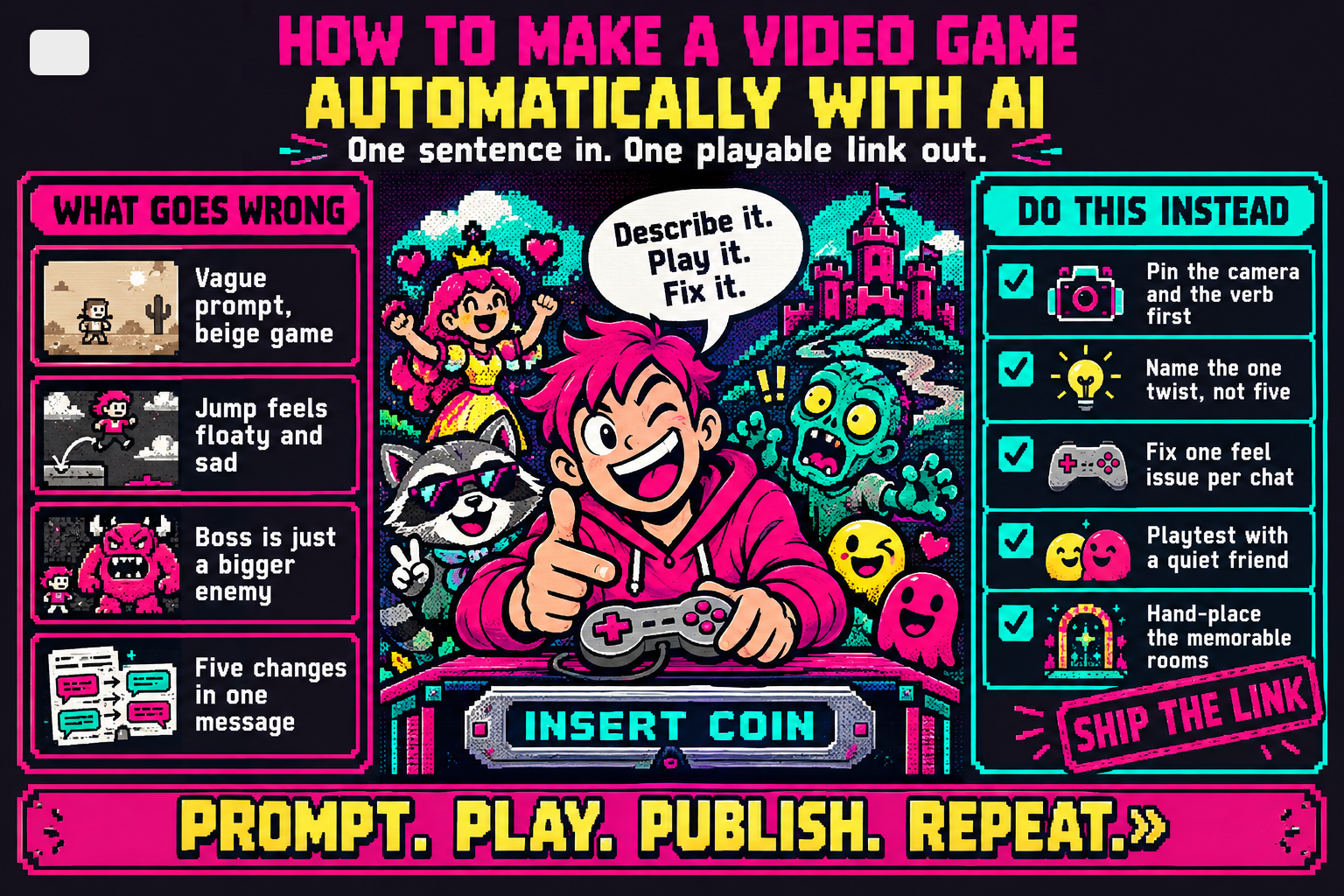
People hear "AI builds the game for you" and picture a slot machine: pull the lever, out drops Zelda. Reality is more interesting and more useful. The AI handles the plumbing most beginners get stuck on, and leaves the fun decisions to you. The parts that need taste still need yours.
So what does "automatic" actually mean when you describe a game in plain English and a working browser build appears a minute later? Which parts are really generated, which parts are stitched together from templates, and where does your judgment still earn its keep?
What "Automatic" Actually Means
Automatic game generation is less one giant model hallucinating a game and more a pipeline of narrower jobs: a language model that writes code against a known framework, a template that already handles input and physics, a library of free assets the AI picks from, and a sandbox that runs the result in your browser. The reason this works is unglamorous. Models from Anthropic, OpenAI, Google and others have Phaser in their training data and can scaffold a working project from a sentence. Three.js is similar for 3D. Give an AI a predictable 2D or 3D engine and a template that boots cleanly, and the "write me a game" prompt stops being science fiction.
The money confirms the shift. The AI-in-games market is projected to grow from $2.88B in 2025 to $3.73B in 2026, and the global games industry it feeds crossed $200B in revenue in 2025. Adoption inside studios is noisy though: in Japan, a 2026 CESA survey put developer use of generative AI at 85.8%, up from 51% a year earlier, while the Game Developer Collective reported adoption dipping to 29% in early 2026. Translation: pros still argue about where it fits. Beginners don't need to. For a browser prototype you can share today, the pipeline is already good enough.
- 1Parse the prompt into genre, verb, win condition, twist and vibe
- 2Pick a template (platformer, runner, shooter, tower defense, puzzle)
- 3Generate code against Phaser (2D) or Three.js (3D)
- 4Pull art and sound from a CC0 library or generate to match style
- 5Rough out levels with procedural rules and seed
- 6Boot the build in the browser for immediate play
- 7Iterate by chat, then publish to a shareable link
What Gets Generated, and What Doesn't
The honest answer is "most of it, badly, until you push back." Code, art, sound, levels, enemy behavior and difficulty tuning all have decent generators. None of them read your mind on the first pass.
- Code. The AI picks a template (shooter, platformer, runner, tower defense), wires input, physics and scenes, and writes the specific rules you asked for. For a 2D side-scroller it drops you onto Phaser; for a 3D runner it drops you onto Three.js. On an AI game maker this is invisible — you describe, it builds.
- Art. Sprites, 3D models, backgrounds and UI come from a built-in CC0 library or get generated to match a style you named ("blocky pastel", "lo-fi pixel"). The AI makes a reasonable choice; you swap what looks wrong.
- Sound. Jump blips, hit thuds, a loop for the menu. Short, functional, replaceable.
- Levels. This is where procedural content generation earns its keep. The AI roughs out a layout, places enemies and pickups against rules you set ("gets harder every 30 seconds", "no two gaps in a row"), and leaves you a seed to re-roll.
- Enemies and tuning. Behaviors come from a menu of patterns (patrol, chase, flee, charge). Numbers like jump height, enemy HP and spawn rate are the AI's best guess until you tell it the jump feels floaty or the second boss is just a bigger first boss.
What doesn't get generated: the reason anyone would play. The core verb, the one-sentence hook, the moment that makes a stranger send the link to a friend. The AI can serve twenty variations of "collect coins while avoiding slimes." Deciding that your coins are haunted and the slimes are the ghosts of previous players is still your job.
From a Sentence to a Shareable Link
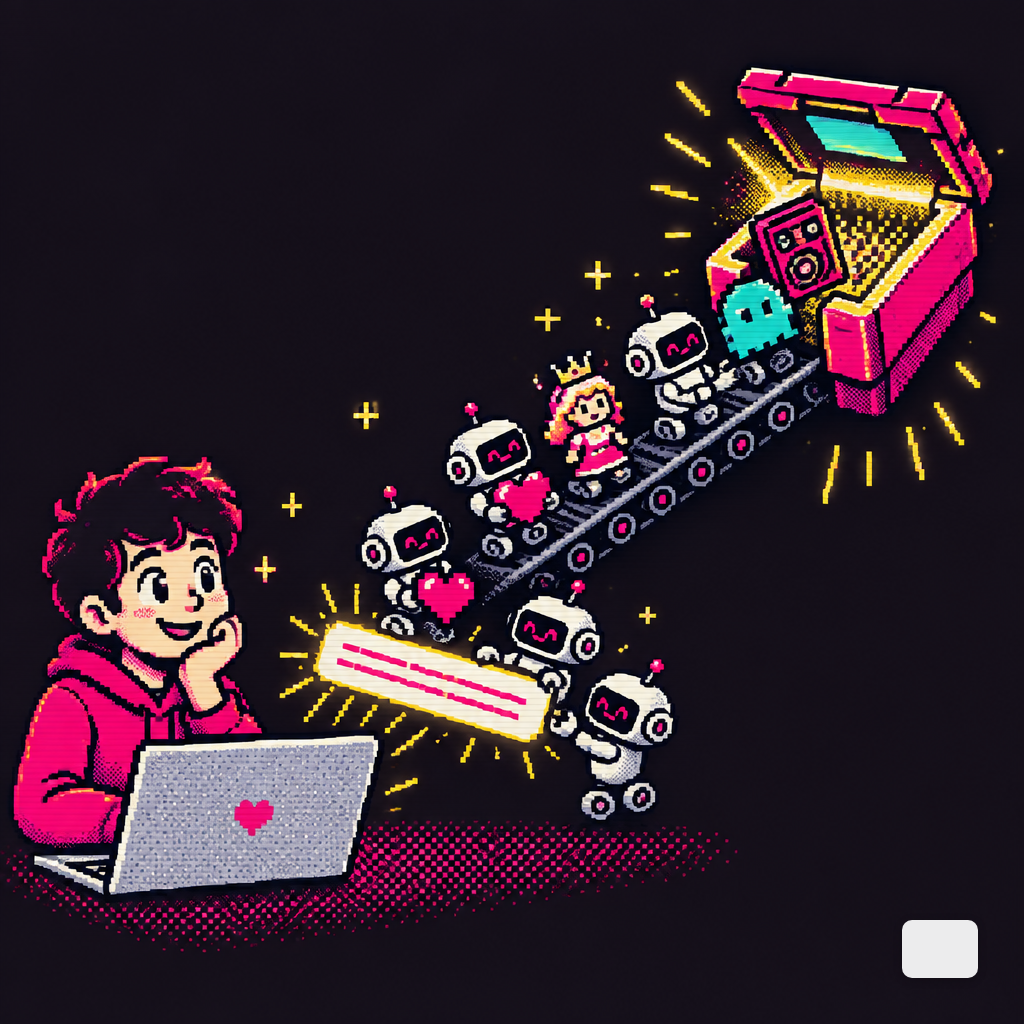
The useful mental model is a loop, not a pipeline. You describe. The system builds. You play. You change one thing by chatting. Repeat until it is good, then publish. The gap between "idea" and "someone else is playing it" has collapsed from weeks to minutes for the simple genres, which is why browser games with AI have gotten so weird so fast.
A prompt pattern that holds up across genres:
- Genre and view. "2D top-down", "3D third-person", "side-scrolling platformer". Pin the camera before anything else.
- Player verb. One sentence. "You are a courier pigeon dodging drones to deliver letters." Verb first, flavor second.
- Win and lose. How a round ends. Score target, three lives, timer, boss defeated. Without this the AI invents something generic.
- One twist. The thing that is not in every other game of this genre. "Letters get heavier the longer you hold them." One is plenty on the first pass.
- Vibe. Two words of art direction and one for sound. "Sunset watercolor, lo-fi jazz." Skip this and you get the default beige.
Feed that to a no code game creator and the first build will be playable and wrong in interesting ways. The wrongness is the point. It gives you something concrete to react to, which is faster than specifying the game perfectly in your head first. A real example of how the first-pass build fails: enemies that phase through walls because the agent forgot to add a collider. One sentence of feedback fixes it.
Where Your Taste Still Earns Its Keep
Research on procedural generation has a quiet consensus that is worth borrowing. In a survey of game developers, control over generation constraints was ranked the most crucial feature of PCG tools, with the ability to mix handcrafted and procedural content close behind. For you, that means: generate the boring parts, hand-place the memorable ones. The AI should build the ten normal rooms. You place the one room that is on fire.
Four decisions the model will not make well for you:
- Feel. Jump arc, acceleration, coyote time, hit stop. These are the difference between crisp and mushy, and a chat-driven "make the jump feel better" fixes them one at a time.
- Difficulty curve. AI tends to flatten. If level three is just level one with faster enemies, say so and ask for a new mechanic instead.
- Economy and pacing. How often rewards land, how long dead time between fights lasts. Only playtest answers this. The Snarky's blog has more on reading your own prototypes without flattering yourself.
- Originality. The AI will cheerfully produce something that looks a lot like a game you already love. Automatic generation does not grant automatic rights. If you want to publish or ship to app stores, keep the names, characters and brands yours.
What the Numbers Say About Where This Is Going
The frontier is widening fast. Google DeepMind's Genie 3 generates interactive 3D environments from a single text prompt at 24fps and 720p, with several minutes of continuous interaction. The earlier Genie model was trained on more than 200,000 hours of gameplay video to learn what "a 2D world" even is. Those models are not yet how shippable games get made, but they tell you where the floor is heading.
Industry sentiment is split, and loudly. In the 2026 State of the Game Industry survey of over 2,300 professionals, 36% reported using generative AI tools while 52% said they believe it is having a negative impact on the industry. Both numbers can be true at once: a tool can be widely useful and widely resented. For a solo creator with no engine installed and a game idea at 11pm, the calculus is different. You are not replacing a team; you are being one.
A Reusable Workflow You Can Run Today
Open an AI game maker in a tab. Paste the five-line prompt pattern above with your own answers. When the first build loads, play it for sixty seconds before typing anything. Make a list of three things in order of how much they bug you: a mechanic that is unclear, a number that feels wrong, an asset that clashes. Fix them one chat message at a time. Do not stack five changes into one prompt or you will not know which one broke what.
Then do the thing most people skip. Share the link with one person who did not watch you build it. Watch them play without talking. The first ten seconds tell you whether the hook landed. If they ask "wait, what am I doing?" the issue is onboarding, not difficulty. If they put it down after the second death, pacing. If they finish and ask for a remix link, you shipped a game. From a sentence. In a browser. Without touching an engine.
Automatic game generation is a lever, not a replacement. The lever is long enough now that one person with an opinion can move something that used to need a team. The opinion is still the part that matters.
Describe a game. Play it seconds later.